Why Windows Kill a Billion Birds a Year, and the Cheapest Fixes That Work
The sound is unmistakable: a dull, hollow thud against glass, then quiet. Sometimes the bird shakes it off and flies away. Often it doesn't. Estimates in the peer-reviewed literature put the number of birds killed by building collisions in the United States somewhere between a few hundred million and nearly a billion each year, with tens of millions more in Canada.
Here's the part that surprises people. Skyscrapers aren't the main problem. Houses, apartment buildings, and low-rise offices account for the bulk of the deaths, simply because there are so many of them and so much of their glass faces trees. That's also the encouraging part: the fixes are cheap, and most of them can be done in an afternoon with a trip to the hardware store.
Why a clean window looks like a forest
Birds don't perceive glass. What they perceive is what the pane reflects — sky, branches, leaves, the hedge across the yard — and they fly toward it. A reflection isn't a warning; it's an invitation. By the time the image resolves into a solid surface, a bird moving at speed has no chance to brake.
Transparency causes the second kind of strike. A pane you can see straight through turns a house into a tunnel: a bird on the lawn spots the houseplant inside, or the far window, and reads it as more open air. Corner windows and glass railings are especially deadly because they offer that see-through view from two directions at once.
At night, the mechanism changes. Many songbirds migrate after dark, using stars and the earth's magnetic field to hold a heading. Brightly lit windows pull them off course, and they end up circling a building until they hit glass or exhaust themselves. This is why the worst collision nights of the year fall during spring and fall migration.
The spacing rule that decides whether a fix works
Not every treatment on the market stops strikes, and the difference usually comes down to one number: how far apart the markings are.
A bird has to read the pattern as a barrier. If the gaps look wide enough to fly through, the bird flies through. The guideline used across collision research is a two-by-four grid: horizontal spacing no wider than two inches, vertical spacing no wider than four inches. Dots in columns two inches apart, with rows four inches apart, satisfy it.
Two other details matter as much as spacing.
- Put it on the outside. The reflection a bird sees forms on the outer surface of the glass. Marks applied indoors sit behind that reflection and are largely invisible to a bird in flight.
- Cover the whole pane. A half-treated window is still a hazard. The pattern needs to span the full sheet of glass, edge to edge.
Cheap fixes, ranked by how well they work
The list runs roughly from best value to largest project, though the right choice depends on whether you want something temporary or something you install once and forget.
- Exterior insect screens. An ordinary screen hung on the outside of a window is one of the most effective and least expensive options available. The mesh breaks up the reflection, and birds that do hit it bounce off fabric rather than glass. If your windows already have screens, consider leaving them up year-round.
- Paracord strands. Hung from a small bracket at the top of the frame and spaced four inches apart, vertical cords read as a barrier while letting in daylight and the view. Materials cost very little, and the cords can be cut to fit a window of any height.
- Tempera paint dots or lines. A bottle of washable tempera and a sponge or small roller will turn a pane into a marked pane in under an hour. Paint dots about an eighth of an inch across on a two-by-four grid, or draw lines to the same spacing. It's the cheapest option for a large window, and it hoses off at the end of the season.
- Dense-pattern tape and film. Purpose-made products cost more than paint but last for years and hold up to weather. Check the specified spacing before buying; if a product doesn't state one, assume it isn't dense enough.
- Netting or shade cloth. Stretched taut two to three inches off the glass, lightweight netting creates a cushion birds hit and rebound from. It works, but it screens the view considerably.
- Awnings, shutters, and exterior shades. These block the reflection itself, which is the cleanest solution of all. They're also the biggest project.
What doesn't work
A single sticker of a hawk, an owl, or a spiderweb in the middle of a pane does essentially nothing. Birds don't recognize the shape as a threat, and there's still plenty of open glass around it.
Interior-only films and decals fall into the same category, for the reason above. So do soap streaks and chalk lines: they can help slightly while fresh, but rain and sun erase them within weeks, and a faded pattern is worse than none because it creates a false sense of security. If you've
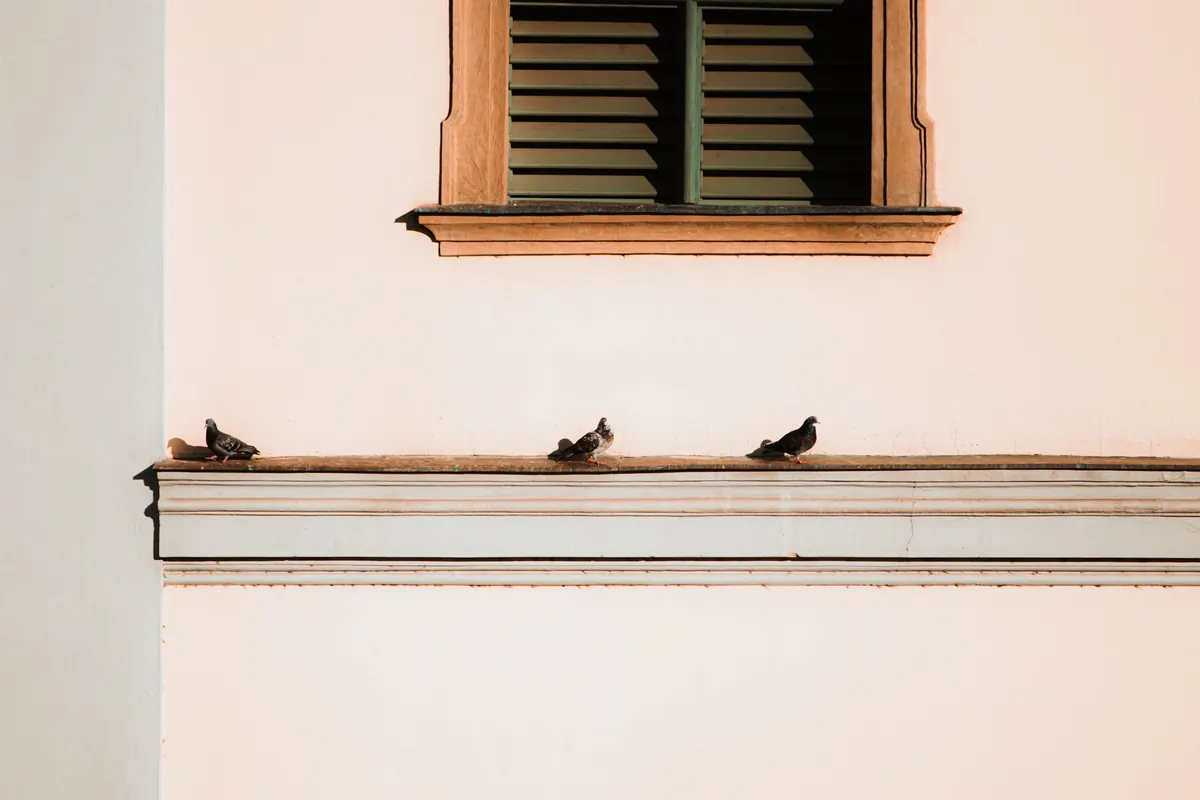
Photo: Keller Chewning / Pexels